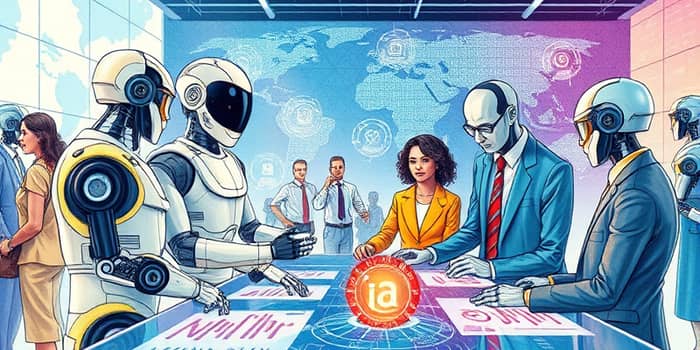
As we navigate 2025, businesses face an era defined by relentless change. From cutting-edge technologies to seismic geopolitical shifts, the ability to track and adapt to disruptive forces has never been more critical.
Defining Disruptive Market Forces
Disruption arises when established norms are upended by technological innovation, shifting consumer behaviors, or swift regulatory changes. It also springs from environmental extremes and geopolitical and trade dynamics that reshape supply chains overnight.
Key disruptors include artificial intelligence, trade policy tension, climate volatility, novel business models, and unpredictable logistics networks. Leaders must learn to anticipate these forces, translating uncertainty into competitive advantage through strategic foresight and agile execution.
- AI and automation
- Geopolitics and trade wars
- Climate change
- New business models
- Supply chain volatility
Key Disruptive Forces in 2025
2025 marks a tipping point where multiple vectors of disruption converge. Executives prioritize technology adoption, supply chain resilience, and sustainability. Yet balancing investment with risk remains a central challenge.
AI, Automation, and Robotics: Eighty percent of executives express optimism about AI’s potential for revenue growth (61%) and cost reduction (39%). Humanoid robots are slated for scale deployment by 72% of CEOs within five years, driving supply chain resilience with real-time analytics. In consumer industries, AI could slash content production costs by 60%, boosting conversion rates up to 20%.
Global Supply Chain Dynamics: Although annual disruption losses have dropped 88% to $184 billion, companies still endure $1.5 million in daily disruption costs. Nearly 94% report revenue hits, with climate events cited by 63% as a prime factor. Fifty percent of organizations now invest in AI and advanced analytics, while multi-shoring and digitization enhance reliability by up to 10 percentage points.
Geopolitics, Trade Policy, and Economic Uncertainty: New tariffs force 74% of firms to revise strategies, and 65% of CEOs relocate manufacturing footprints amid US–China tensions. Trade fragmentation could shave global growth to 2.3% in 2025, costing the financial system up to $5.7 trillion. Inflation, interest-rate volatility, and policy shifts prompt more than half of executives to temper growth plans.
Environmental and Social Pressures & New Business Models: Climate change disrupts supply chains and fuels regulatory demands for stronger ESG performance. Companies pivot to circular, subscription, and experience-based models—proving that innovative delivery and pricing can unsettle markets without new technology breakthroughs.
Sector-Specific Developments and Case Studies
Across industries, disruptive forces manifest uniquely, demanding tailored strategies and investments.
Technology Sector: Hyperscalers like AWS, Azure, and Google Cloud experience uneven growth as AI workloads surge. Companies that integrate generative AI tools into development pipelines report productivity gains of up to 30%, while laggards risk falling behind in developer talent acquisition.
Manufacturing and Semiconductors: The US commits over $500 billion to domestic chipmaking, aiming to secure supply chains and spur innovation. Manufacturers adopting advanced robotics and AI-driven quality control report defect rates dropping by 25%.
Ports and Logistics: The Port of Los Angeles anticipates a 35% reduction in China-linked cargo, forcing carriers and retailers to reroute shipments. Firms embracing digital supply network platforms gain greater visibility, reducing lead times by 15%.
Retail: Subscription-based and omnichannel models reshape consumer engagement. Several major retailers plan large-scale consolidations or carve-outs to streamline operations amid volatile demand and shifting shopping habits.
Quantitative Highlights and Market Data
Key metrics underscore the scale and scope of disruption in 2025. Understanding these figures equips leaders to calibrate investments and risk management frameworks.
Implications for Business Leaders
Leaders must prioritize resilience, innovation, and trust-building to thrive. That involves integrating emerging technologies, redesigning ecosystems, and fostering a culture agile enough to pivot strategies rapidly.
- Invest in AI, advanced analytics, and digital supply networks.
- Embed sustainability and ESG into core operations.
- Develop flexible policies to navigate regulatory and geopolitical shifts.
Emerging Themes & Open Questions
As disruption accelerates, new questions arise. How will workforce dynamics evolve as AI reshapes roles? Can regulatory frameworks keep pace with rapid technological change? Will green supply chains become a universal differentiator?
- AI and the future of work: reskilling needs and job creation.
- Trade and resource security: achieving self-sufficiency in critical industries.
- Environmental adaptation: business continuity amid climate volatility.
Conclusion
In 2025, navigating disruptive market forces demands vision, agility, and purposeful action. By embracing innovation, reinforcing resilience, and anticipating emerging risks, business leaders can transform disruption into sustained competitive advantage.
References
- https://www.alixpartners.com/newsroom/2025-alixpartners-disruption-index/
- https://procurementtactics.com/supply-chain-statistics/
- https://www.binomialconsulting.com/post/adapting-market-disruption-examples-trends-and-how-to-overcome-in-2025
- https://randtech.com/state-of-the-market-q2-2025-global-disruption-strategic-shifts-and-opportunities-across-the-technology-supply-chain/
- https://www.disruptiveleadership.institute/megatrends-future-disruptors/
- https://tradeverifyd.com/resources/supply-chain-statistics
- https://www.bcg.com/publications/2025/ten-forces-reshaping-global-business
- https://www.weforum.org/stories/2025/08/inflection-points-7-global-shifts-defining-2025-so-far-in-charts/
- https://www.innosight.com/insight/six-disruptive-forces/
- https://www.deloitte.com/us/en/insights/industry/manufacturing-industrial-products/manufacturing-industry-outlook.html
- https://www.rbc.com/en/economics/us-analysis/us-featured-analysis/five-disruptors-to-the-u-s-economic-cycle/
- https://tax.thomsonreuters.com/blog/2025s-supply-chain-challenge-confronting-complexity-and-disruption-in-global-trade-tri/
- https://www.mckinsey.com/capabilities/strategy-and-corporate-finance/our-insights/economic-conditions-outlook
- https://www.citrincooperman.com/In-Focus-Resource-Center/From-Disruption-to-Opportunity-2025-Consumer-Products-Retail-Subsector-Outlook
- https://www.ey.com/en_us/megatrends/what-if-disruption-is-not-the-challenge-but-the-chance
- https://www.emarketer.com/topics/category/disruption
- https://hileyhunt.com/disruptive-forces/
- https://unctad.org/publication/global-trade-update-september-2025-trade-policy-uncertainty-looms-over-global-markets