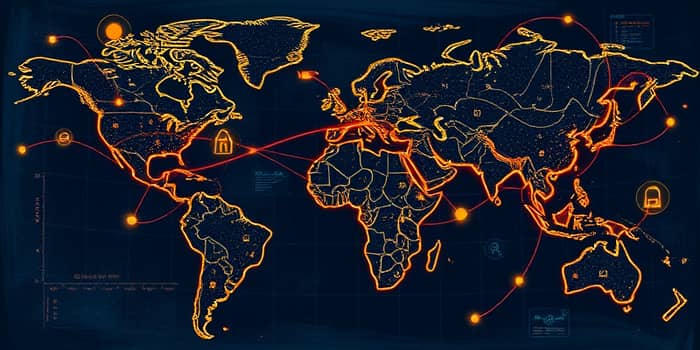
In an increasingly interconnected world, global events can send ripples through financial markets, trade networks, and corporate strategies. Understanding these dynamics is essential for investors and business leaders seeking resilience.
Definition and Scope of Geopolitical Risks
Geopolitical risks shape the global economy by introducing uncertainty into markets and supply chains. These risks encompass government actions, conflicts, and policy shifts that can alter trade flows and investment decisions.
By definition, events related to political instability may include armed conflicts, sanctions, trade disputes, and cyber-attacks. Such occurrences can trigger supply chain disruptions, price volatility, and shifts in capital flows.
For investors, recognizing state-level policy shifts that influence markets is crucial. From tariff changes to nationalist legislation, these developments can impact inflation, growth, and financial stability across regions.
Major Geopolitical Flashpoints Impacting Markets (2024–2025)
Several regions have dominated headlines and market analyses. These flashpoints carry both immediate and long-term implications for energy security, commodity prices, and global trade.
- Russia-Ukraine War: Continues to maintains elevated inflation rates globally through energy price shocks, food supply constraints, and European energy insecurity.
- Israel-Hamas Conflict & Middle East Tensions: Drive higher insurance costs for shipping firms, spikes in crude oil prices, and increased market volatility.
- U.S.-China Rivalry: Leads to technology decoupling and supply chain rerouting, with 29% of CEOs citing decoupling as a top operational risk and U.S. tariffs averaging 18.2% by mid-2025.
- Taiwan Strait Dynamics: Heightened military posturing threatens critical semiconductor production, risking global electronics and automotive supply chains.
- Energy Transition Conflicts: Fossil fuel economies resist decarbonization, causing investment shifts toward renewables and increased volatility in oil and gas markets.
- Cybersecurity Threats: Attacks on energy grids, financial institutions, and public utilities intensify market uncertainty and can trigger rapid sell-offs.
Recognizing these flashpoints and their cascading effects enables stakeholders to anticipate and respond proactively to market shifts.
Economic & Market Consequences of Geopolitical Events
Geopolitical shocks often translate into measurable market movements. On average, stock indices drop by roughly 2.5% when major trading partners engage in military conflicts. Government bond yields rise, reflecting heightened risk premiums, and currency markets react to flight-to-safety flows.
Trade fragmentation further amplifies these effects. Rising tariffs and realigned alliances push businesses to source from politically aligned partners, driving up costs and complexity. The financial burden of a more fragmented system is estimated between $0.6 trillion and $5.7 trillion in 2025 alone.
Energy and commodity price swings directly feed into inflation measures. U.S. and Eurozone inflation rates have remained above pre-pandemic levels, partly due to supply interruptions in oil, gas, and agricultural markets. Consumers and businesses face higher input costs, eroding real incomes and profit margins.
Capital flows shift in response to geopolitical risk. While the U.S. dollar retains its safe-haven status, smaller interest-rate differentials may reduce its yield advantage, leading to potential downward pressure on the currency. Sovereign bond yields across major economies are expected to stay elevated as central banks maintain cautious monetary policies.
Corporate strategies adapt through onshoring, nearshoring, and increased investment in risk mitigation. Companies are diversifying supplier bases and reevaluating investment locations to reduce exposure to geopolitical hotspots.
The Rise of Protectionism and Policy Shifts
Protectionist measures and nationalist policies have gained momentum as governments seek to safeguard domestic industries. Tariffs, export controls, and subsidies are on the rise, complicating cross-border trade.
The U.S. average effective tariff rate climbed sharply, with July 2025 marking an average effective US tariff rate rose to 18.2%, the highest since 1934. In response, businesses are negotiating bilateral agreements or shifting production to avoid punitive rates.
This trade realignment has fostered pragmatic alliances and bilateral deals, as nations balance protectionism with the need for economic cooperation. Companies must track policy changes closely to optimize supply costs and comply with evolving regulations.
Sector-Specific Market Impacts and Emerging Themes
Different industries face unique vulnerabilities and opportunities amid geopolitical turbulence.
- Commodities & Energy: Oil and natural gas prices remain highly sensitive to developments in Russia, Venezuela, and the Persian Gulf. Renewables investments surge under policies like the U.S. Inflation Reduction Act.
- Technology & Semiconductors: Tensions in Taiwan and U.S.-China decoupling put critical chip manufacturing at risk, potentially disrupting global electronics production.
- Financial Services: Increased cyber threats and market volatility challenge banks and asset managers, requiring stronger risk management protocols.
- Agriculture & Food Security: Conflict-driven disruptions in grain exports lead to price hikes and food shortages, particularly in import-dependent regions.
Long-term strategic shifts include competition for critical minerals essential to decarbonization, growing cyber resilience investments, and the emergence of digital trade corridors. Businesses are navigating a balance between deglobalization trends and the pursuit of new regional trade blocs.
Actionable Insights and Forward-Looking Considerations
To thrive in a world marked by geopolitical uncertainty, market participants must:
- Develop flexible supply chains through diversification, multiple sourcing, and strategic inventories.
- Invest in diversification, cybersecurity, and scenario planning to anticipate shocks and protect assets.
- Monitor key indicators such as tariff announcements, energy price fluctuations, and corporate profit warnings.
- Engage in policy advocacy and maintain dialogue with regulators to shape favorable trade environments.
- Adopt advanced analytics to model geopolitical scenarios and stress-test financial portfolios.
By embedding these practices, organizations can enhance resilience, capitalize on emerging opportunities, and mitigate downside risks.
Conclusion
Geopolitical events will continue to exert profound influence on markets, trade, and corporate strategies. Staying informed, agile, and proactive is no longer optional—it is a strategic imperative for any entity operating on the global stage. By understanding the evolving landscape and acting on actionable insights, stakeholders can turn risks into opportunities and build sustainable competitive advantages.
References
- https://www.spglobal.com/en/research-insights/market-insights/geopolitical-risk
- https://www.shrm.org/enterprise-solutions/insights/top-5-geopolitical-threats-to-businesses-2025
- https://www.esma.europa.eu/press-news/esma-news/heightened-geopolitical-uncertainties-drive-risks
- https://www.weforum.org/stories/2025/08/inflection-points-7-global-shifts-defining-2025-so-far-in-charts/
- https://www.ey.com/en_us/insights/geostrategy/2025-geostrategic-outlook
- https://www.imf.org/en/blogs/articles/2025/04/14/how-rising-geopolitical-risks-weigh-on-asset-prices
- https://www.blackrock.com/corporate/insights/blackrock-investment-institute/interactive-charts/geopolitical-risk-dashboard
- https://www.goldmansachs.com/insights/articles/the-new-york-times-how-to-know-when-a-world-event-could-shock-the-market
- https://kpmg.com/xx/en/our-insights/risk-and-regulation/top-risks-forecast-2025.html
- https://www.federalreserve.gov/econres/notes/feds-notes/measuring-geopolitical-risk-exposure-across-industries-a-firm-centered-approach-20250829.html