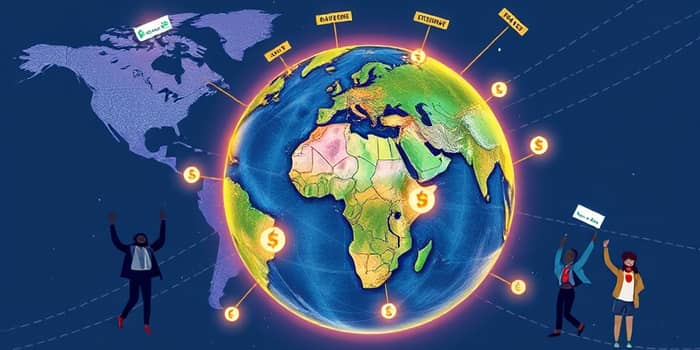
In an era where money flows as freely as information, cross-border payments are undergoing a profound transformation. This revolution not only promises unprecedented expansion and efficiency but also holds the power to uplift individuals, businesses, and economies around the globe. By harnessing cutting-edge technologies and cooperative frameworks, we can make international transactions faster, cheaper, and more secure than ever before.
Market Dynamics and Unstoppable Growth
The global cross-border payments market soared to nearly $1 quadrillion in 2024 and is projected to climb from $194.6 trillion to $320 trillion by 2032. These figures reveal a sector growing at a staggering 9% annual rate. Such remarkable growth trajectories underscore the urgent need for scalable solutions that can keep pace with expanding demand.
Bank credit for cross-border transactions reached $37 trillion in Q2 2025, marking a year-on-year increase of 10%. This influx of capital reflects the confidence that financial institutions place in an interconnected world economy.
User Behavior: Adoption Patterns and Preferences
Consumer engagement is at an all-time high. Between June 2023 and June 2024, 771 million people made cross-border transactions. Among them:
- 30% purchase goods from international e-commerce weekly
- 45% send or receive remittances monthly
- 66% travel abroad at least once a year
Despite this enthusiasm, only 16% rely on a single payment method consistently. Digital wallets, however, are gaining traction, with remittance volumes growing by 33% year-over-year and reaching $29 billion.
Overcoming Cost Barriers
High fees continue to plague certain payment corridors. Nearly one-quarter of routes carry costs above 3%, with remittance fees averaging 7.7% to sub-Saharan Africa and 6.2% to South Asia. Achieving the Sustainable Development Goal target of 3% remains an uphill battle.
Recent reports highlight minimal global cost improvements, and in some regions, costs have even worsened. Tackling these challenges demands innovative fee structures and greater market competition.
Accelerating Payment Speed
Speed is equally critical. One-third of retail cross-border payments take more than one business day to settle. Yet progress is evident:
- Wholesale payment speeds have improved globally
- Remittance processing times are decreasing
By prioritizing near-instant transfers, businesses can optimize cash flow, reduce liquidity risks, and respond swiftly to market opportunities.
Fostering Security and Trust
Cyber threats loom large, with 88% of organizations reporting payment fraud incidents in 2022–2023. Global cybercrime costs are estimated at $10.5 trillion annually. Strengthening security protocols and adopting robust fraud detection tools are non-negotiable.
Machine learning and AI-driven systems can detect anomalies in real time, enabling institutions to prevent losses and maintain customer confidence.
Technological Innovations Paving the Way
Several key technologies are reshaping the landscape:
Over 70 countries now offer real-time payment rails, and initiatives like SWIFT gpi and domestic systems (Brazil’s Pix, India’s UPI) are converging. ISO 20022 adoption enriches transaction data, improving straight-through processing rates and reducing false positives.
Regulatory Landscape and Compliance
Governments and regulators are intensifying scrutiny. Stricter anti-money laundering standards and evolving tax compliance frameworks (e.g., FATF recommendations, GDPR, LGPD) require businesses to implement stronger risk management protocols and maintain transparent audit trails.
Proactive engagement with regulators can accelerate approval timelines and foster trust among stakeholders.
Looking Ahead: Trends and Opportunities for 2025 and Beyond
Emerging trends promise to further transform cross-border payments:
- Local currency settlements to mitigate FX volatility
- Expanded clearing networks in emerging markets
- Greater interoperability through initiatives like BIS Project Nexus
These advancements will drive financial inclusion, empower small businesses, and support migrant communities by reducing costs and improving access.
Empowering Businesses and Individuals
Small and medium-sized enterprises, often hampered by high fees and slow transactions, stand to gain significantly. Streamlined cross-border solutions can open new markets, optimize working capital, and level the playing field against larger competitors.
Migrant workers and vulnerable populations will benefit from lower remittance costs and faster settlement times, directly impacting their economic well-being.
A Call to Action
To fully realize the promise of speed and savings, stakeholders must collaborate. Financial institutions, fintech innovators, regulators, and end users all have a role to play:
- Embrace open standards and real-time infrastructures
- Invest in AI-driven security and compliance tools
- Foster partnerships that bridge domestic and global systems
By working together, we can ensure that cross-border payments become not just faster and cheaper, but truly transformative—empowering communities and driving inclusive growth.
Conclusion: Shaping a Borderless Future
The reinvention of cross-border payments is more than a technological shift; it is a catalyst for global prosperity. As we harness real-time rails, enriched data standards, and advanced security measures, we pave the way for a world where money moves as freely and reliably as ideas.
Let us seize this moment to build an interconnected financial ecosystem that leaves no one behind—where every transaction brings us closer together, fuels innovation, and creates lasting impact.
References
- https://www.fsb.org/2025/10/g20-roadmap-for-cross-border-payments-consolidated-progress-report-for-2025/
- https://conduitpay.com/blog/7-cross-border-payment-trends-to-watch-in-2025
- https://corporate.visa.com/en/sites/visa-perspectives/innovation/the-past-present-and-future-of-cross-border-money-movement.html
- https://www.jpmorgan.com/insights/payments/fx-cross-border/2025-trends-for-financial-institutions
- https://www.bis.org/statistics/rppb2510.htm
- https://www.ecb.europa.eu/press/key/date/2025/html/ecb.sp250627~de084f5b69.en.html
- https://www.imf.org/en/publications/wp/issues/2025/06/13/global-cross-border-payments-a-1-quadrillion-evolving-market-567604
- https://www.mckinsey.com/industries/financial-services/our-insights/global-payments-report
- https://www.statista.com/topics/11647/cross-border-payments/