In today’s fast-paced world, investors and producers alike face economic, geopolitical, and market uncertainty at every turn. From inflationary surges to supply chain disruptions and unexpected policy shifts, traditional assets often struggle to provide stability when it matters most.
Enter commodities: tangible assets that have served as an essential hedge for investors across generations. By understanding their role and strategic potential, you can fortify your portfolio against the storms of volatility.
Understanding Commodities and Their Markets
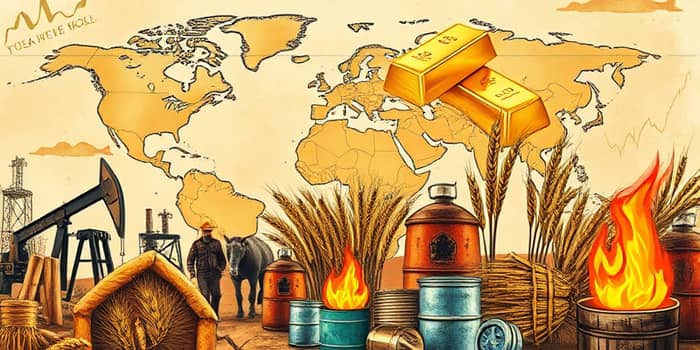
Commodities are raw materials traded on global exchanges. They encompass energy products such as oil and natural gas, metals like gold and copper, and agricultural goods including soybeans and corn.
Price movements in these markets are driven by supply-demand dynamics, geopolitical developments, weather patterns, and macroeconomic trends. Unlike equities and bonds, commodities do not generate interest or dividends, but they offer diversification and risk management benefits that can prove invaluable.
The Historical Role of Commodities in Crises
Throughout history, periods of crisis have illuminated the protective power of commodities. In the 2008 financial crisis, broad commodity indices experienced fewer losses than equities. During the COVID-19 pandemic, certain agricultural commodities rallied as supply chains adjusted to shifting consumer behavior.
Most recently, in 2022, inflationary pressures propelled a broad-based commodity indices significantly outperform traditional asset classes, delivering double-digit gains over equities while stocks and bonds stumbled.
Empirical Evidence: Data and Statistics
Academic and industry studies consistently highlight commodities’ ability to buffer against various uncertainties. Key findings include:
- Studies indicate a 6.7% allocation to commodities in a 60/40 portfolio significantly enhances inflation protection and risk-adjusted returns.
- During high-inflation years, the Bloomberg Commodity Index outperformed equities and bonds by double digits, underscoring the third pillar for portfolio construction.
- Commodity trading generated over $100 billion EBIT in 2023, demonstrating robust performance even amid market instability.
Volatility trends also reveal resilience: from 2022 to 2023, price volatility fell by 30% for WTI crude oil, 58% for Dutch TTF natural gas, and 38% for Henry Hub natural gas.
Portfolio Construction: Strategies for Hedging
Incorporating commodities into a diversified portfolio can be achieved via multiple vehicles:
- Futures contracts to lock in prices and hedge production costs.
- Options on commodity futures for limited risk exposure and strategic leverage.
- Commodity-linked ETFs for straightforward access and liquidity.
Research suggests that an incremental allocation of 4%–9% to commodities can meaningfully improve portfolio resilience. A higher allocation may boost returns during inflationary cycles, but it also introduces high price volatility and risk, so balance is key.
Comparing Commodities to Traditional Safe-Havens
Gold and government bonds have long been considered go-to safe-haven assets. However, they can falter during certain crises, such as stagflation or sharp supply shocks.
Commodities offer a complementary hedge. For example, soybeans and corn respond uniquely to geopolitical tensions and climate events, while energy commodities react sharply to policy shifts in global oil markets.
By mixing commodities with gold and bonds, investors can achieve negative or low correlation profiles, improving overall portfolio robustness.
Risks and Limitations to Consider
While commodities present compelling advantages, they are not without drawbacks. Key considerations include:
- High price volatility and risk driven by geopolitical crises, weather, and demand shocks.
- Absence of income yield—commodities do not pay dividends or interest.
- Uncertain long-term returns that can fluctuate widely depending on global economic cycles.
Investors must employ disciplined strategies, monitor exposures, and adjust allocations as market conditions evolve. Combining fundamental analysis with technical insights can help identify entry and exit points.
Conclusion: Embracing Commodities in Uncertain Times
As we navigate an era marked by inflationary pressures, geopolitical tensions, and rapid policy shifts, commodities stand out as a resilient hedge.
Whether you are a producer seeking to stabilize revenues or an investor aiming to diversify risk, integrating a targeted commodity allocation can offer a powerful layer of protection. By balancing potential rewards with inherent risks, you can harness the diversification and risk management qualities of commodities to build a more resilient portfolio.
Ultimately, commodities represent more than mere raw materials—they embody a strategic defense against the unknown, reminding us that in the face of uncertainty, preparedness and prudent allocation can make all the difference.
References
- https://pmc.ncbi.nlm.nih.gov/articles/PMC9465658/
- https://www.fnb-online.com/business/knowledge-center/manage-risk/managing-risk-in-commodities-markets-with-hedging-strategies
- https://www.nasdaq.com/articles/why-invest-commodities-pros-and-cons
- https://resonanzcapital.com/insights/the-case-for-commodities-a-strategic-allocation-for-long-term-investors
- https://www.mckinsey.com/industries/electric-power-and-natural-gas/our-insights/the-critical-role-of-commodity-trading-in-times-of-uncertainty
- https://www.schroders.com/en-us/us/individual/insights/commodities-a-geopolitical-hedge-in-an-uncertain-world-podcast-highlights/