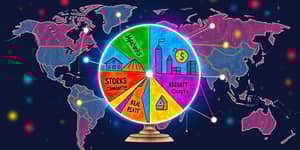
In an era of interconnected markets, understanding how money moves across borders is essential for business leaders, policymakers, and informed citizens alike. Capital flows shape economic destinies, drive development, and influence everyday lives in profound ways.
Understanding Capital Flows: Definitions and Scope
At its core, a capital flow is the cross-border movement of money for investment, trade, or production. These flows are recorded in a nation’s balance of payments under the financial account, distinguishing between inflows (funds entering a country) and outflows (funds leaving a country).
Capital flows allocate global savings efficiently, channeling resources from capital-rich economies to those with pressing investment needs. This allocation sustains infrastructure projects, supports businesses, and fuels innovation around the world.
Types of Capital Flows
Money can travel globally through a variety of financial instruments and channels, each with its own risk, duration, and strategic role.
Beyond these financial vehicles, flows are also categorized by source (private vs. official), maturity (short-term vs. long-term), and risk hierarchy (debt vs. equity vs. FDI). Understanding these distinctions helps stakeholders gauge stability, potential returns, and systemic vulnerabilities.
Drivers and Determinants of Capital Movement
Why does capital surge into one economy and retreat from another? The answer lies in a combination of global and local factors.
- Pull Factors: High growth prospects, stable policies, robust institutions, and investment-friendly reforms attract funds.
- Push Factors: Global interest rates, economic uncertainty, and risk aversion drive capital toward safe havens or away from volatile markets.
- Policy Choices: Liberalized capital accounts can invite large inflows, while capital controls may dampen volatility.
These drivers are interlinked, creating a dynamic landscape that evolves with macroeconomic cycles, political shifts, and technological changes.
Policy Tools and Controls
Governments have developed a toolkit to manage surges and sudden stops in capital. Capital controls—including taxes on inflows, limits on overseas transfers, and reserve requirements—help mitigate destabilizing waves of money. The IMF recognizes these measures as legitimate tools during crises.
Building deep domestic financial markets and local currency instruments can also cushion economies from external shocks. By fostering resilient banking sectors and robust capital markets, nations reduce their exposure to abrupt reversals of foreign funds.
Impacts on Economies and Societies
Capital flows can ignite economic expansion by closing savings gaps and funding infrastructure, factories, and high-tech ventures. Empirical evidence from 77 low- and middle-income countries between 1980 and 2012 shows that a 1 percent rise in net inflows as a percentage of GDP significantly boosted investment and growth.
Yet, this benefit comes with trade-offs. Large capital inflows often appreciate local currencies, making exports less competitive. Conversely, sudden outflows can trigger sharp depreciation, deplete reserves, and precipitate crises.
Income inequality may also widen when speculative short-term flows dominate, as seen in emerging markets. A study covering 2001–2018 found a positive correlation (coefficient ~0.3) between net private capital inflows (% of GDP) and increases in the Gini coefficient. In contrast, Argentina’s net outflows contributed to a drop in its Gini index from 45.1 to 38.8.
Long-term investments, especially FDI, tend to support job creation, technological diffusion, and sustainable development. Countries that foster an inviting environment for responsible investors often reap lasting socioeconomic gains.
Emerging Trends and Real-World Examples
Capital flows are shifting away from traditional Western financial centers toward dynamic hubs in Asia and the Gulf. The UAE, for example, plans to double its cumulative FDI to $354 billion and reach a total FDI balance of $600 billion by 2031. Singapore and other Asian powerhouses continue to deepen regional and global linkages.
- Global liquidity now chases local pull factors—sound institutions, digital infrastructure, and strong governance.
- Sovereign wealth funds increasingly invest domestically, targeting supply-chain security and strategic industries.
- Green and impact investments are on the rise, channeling funds into sustainable energy and social enterprises.
These patterns underscore a broader shift: capital is no longer passive but strategic, seeking not only financial returns but also resilience and long-term value creation.
Risks and Challenges
Despite the immense opportunities, capital flows carry inherent risks. “Hot money”—short-term, speculative investments—can spark asset bubbles and accelerate outflows at the first hint of trouble. Currency mismatches on corporate and sovereign balance sheets amplify vulnerability when foreign-currency debt is excessive.
Policymakers must balance openness with prudence. Overreliance on volatile flows demands hefty policy buffers, including ample foreign reserves, robust regulatory frameworks, and clear communication strategies to maintain investor confidence.
Conclusion: Navigating Future Capital Flows
As global finance enters a new era of complexity, stakeholders must cultivate a vision that blends ambition with resilience. For policymakers, this means fine-tuning regulations, enhancing market depth, and pursuing strategic partnerships. For businesses and investors, it involves rigorous risk assessment, ethical stewardship, and alignment with sustainability goals.
Capital flows will continue to reshape economic landscapes, bridging gaps and igniting progress. By understanding the forces at play, we can harness these powerful currents of finance to build more inclusive, dynamic, and resilient economies for generations to come.
References
- https://www.tradingview.com/chart/EURUSD/nBNietB4-Capital-Flows-Concept-and-Characteristics/
- https://www.scirp.org/journal/paperinformation?paperid=82645
- https://corporatefinanceinstitute.com/resources/economics/capital-flows/
- https://www.frbsf.org/research-and-insights/publications/economic-letter/2021/03/capital-flow-surges-and-rising-income-inequality/
- https://www.tandfonline.com/doi/full/10.1080/1540496X.2025.2482723?src=
- https://diversification.com/term/capital-flows
- https://www.weforum.org/stories/2025/02/why-capital-flows-have-the-potential-to-change-the-economic-status-quo/
- https://www.wallstreetoasis.com/resources/skills/economics/capital-flows
- https://www.imf.org/-/media/Files/Publications/PP/2022/English/PPEA2022009.ashx
- https://www.nber.org/programs-projects/projects-and-centers/8297-economic-consequences-rise-capital-flows